Surrogates & Bayesian optimization (Layer 5)
When each evaluation is expensive (a GetDP solve, a transient FEA run, a dyno test), the roughly 10³ evaluations a genetic algorithm needs are not affordable. Bayesian optimization finds comparable designs in tens of evaluations by spending compute on deciding where to evaluate next.
Code: axfluxmdo.optimize.dataset,
surrogate, bayesopt,
axfluxmdo.viz.bayesopt. Requires
pip install "axfluxmdo[opt]" (scikit-learn + scipy).
1. Gaussian-process regression in five lines
Given \(n\) observations \(\mathbf y\) at inputs \(X\), a GP with kernel \(k(\cdot,\cdot)\) predicts at a new point \(x_*\):
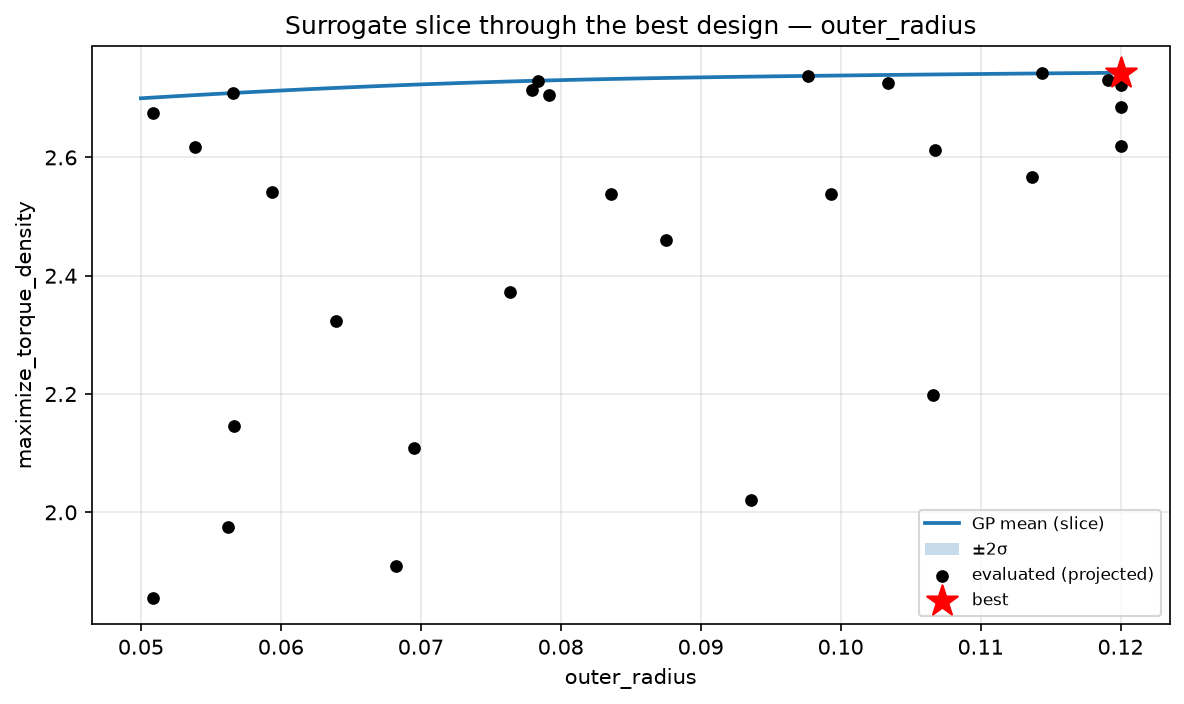
where \(K_{ij} = k(x_i, x_j)\) and \((\mathbf k_*)_i = k(x_i, x_*)\). The mean interpolates the data, and the variance grows away from it. That variance is the quantity that drives exploration.
The kernel is a Matérn-5/2 with ARD (automatic relevance determination, meaning one length scale per input dimension):
ARD matters here because the feature encoding mixes scales (meters,
unitless fill factors, ordinal pole counts), and per-dimension \(\ell_j\) let
the GP learn each variable's influence after standardization. Length
scales are fit by maximizing the marginal likelihood; trustworthiness is
judged by k-fold cross-validation (cv_rmse/cv_r2), not by the optimizer's
convergence warnings.
2. Expected improvement, derived
Let \(y^\*\) be the best (minimize-space) value observed so far. The improvement at \(x\) is \(\max(0,\ y^\* - Y)\) where \(Y \sim \mathcal N(\mu, \sigma^2)\) is the GP's belief. Its expectation:
Substituting \(z = (y^\* - \mu - \xi)/\sigma\) (with a small exploration margin \(\xi\)) and integrating by parts:
The two terms have direct interpretations: exploitation (probability-weighted improvement of the mean) plus exploration (reward for uncertainty). EI goes to zero as \(\sigma \to 0\), so the optimizer does not re-evaluate points it already knows. The acquisition is maximized over a seeded candidate pool (half uniform, half perturbations of the incumbent), which is derivative-free and correct for the mixed continuous/integer/choice space.
3. The loop
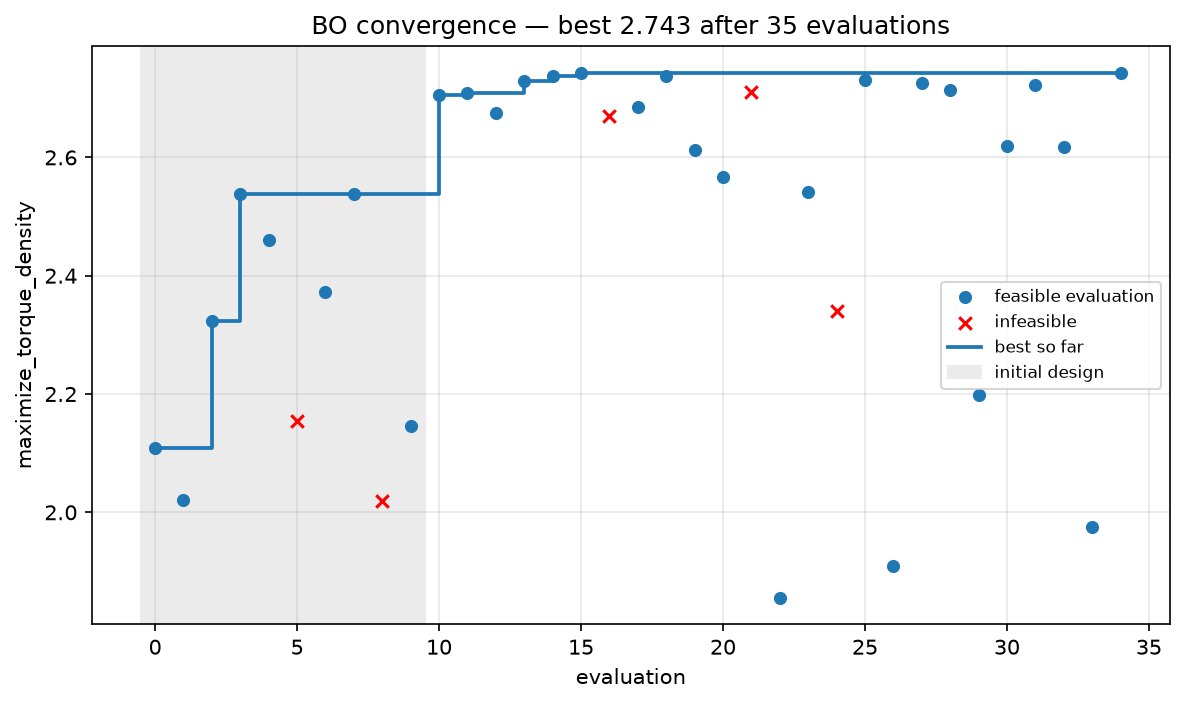
- Initial design: a Latin hypercube over the continuous/integer box. Stratified sampling guarantees one-dimensional coverage that i.i.d. uniform sampling does not. Choice variables use seeded random draws.
- Fit the GP. Infeasible points receive a soft penalty (worst feasible value plus 10% of the feasible range) rather than the 10⁹ geometry penalty, which would destroy the smoothness the GP depends on.
- Maximize EI, evaluate the winner, and append it to the
DesignDataset(JSON Lines with a versioned header, so every evaluation is a permanent artifact). - Repeat. The same seed produces an identical trajectory (test-pinned).
On the reference problem, BO reaches the genetic algorithm's torque-density optimum in 35 evaluations versus roughly 1200, and slightly exceeds it because the local perturbation pool polishes the incumbent.
4. Uncertainty-aware recommendation
BOStudy.recommend(k, risk_aversion=κ) ranks evaluated, verified-feasible
designs by the pessimistic score \(\mu - \kappa\sigma\) (maximize sense). A
design the surrogate is unsure about ranks below a slightly worse one with
verified neighbors. The ranking covers only evaluated designs; it makes no
claim about unevaluated space.
5. Expensive objectives
Any callable can be the objective; the cheap model still supplies the constraints:
from axfluxmdo.solvers import solve_open_circuit

def fea_b1(motor, op):
    return {"fea_b1_t": solve_open_circuit(motor, magnet_temp_c=65.0).fundamental_b1_t}

study = bayesian_optimize(
    motor, op,
    variables={"magnet_thickness": (0.002, 0.008), "air_gap": (0.0005, 0.0015)},
    objective="maximize_fea_b1_t",
    expensive_fn=fea_b1,
    n_initial=6, n_iterations=12,
)
See example 07 for the 35-evaluation study, convergence and surrogate-slice plots, the dataset round-trip, and the FEA-objective recipe.