Pareto optimization & MDO (Layer 3)
The optimization layer turns the microsecond models into design studies: multi-objective Pareto fronts over mixed continuous/discrete variables, one-at-a-time sensitivities, and an OpenMDAO component for gradient-based refinement and larger coupled MDO groups.
Code: axfluxmdo.optimize.problem,
pymoo_runner, sensitivity,
openmdao_components. Requires pip install
"axfluxmdo[opt]".
1. The problem grammar
DesignProblem is the single parsing layer every backend shares:
- Variables:
{"outer_radius": (0.05, 0.12)}. A 2-tuple is a continuous bound (integer bound if the motor field is an int); a list is a discrete choice set ("pole_pairs": [8, 10, ...]). Dotted paths reach nested fields:"tolerances.runout_m". - Objectives:
"maximize_torque_density"or"minimize_mass". The suffix resolves through the alias map to a stable result key. - Constraints:
"winding_temp_c < 140", parsed to the standard \(g(x) \le 0\) convention. The models' built-in constraint records are enforced in addition by default, so optimizer output is alwaysresult.feasible.
Design vectors that violate geometric validity (e.g. \(r_i \ge r_o\)) are penalized with large finite values rather than raised; genetic algorithms bury them through constrained domination.
2. Pareto optimality, briefly
A design \(x\) dominates \(y\) if it is no worse in every objective and strictly better in at least one. The Pareto front is the set of non-dominated feasible designs. Any design off the front is beaten in every objective by some design on it, so the front is the complete answer to a multi-objective sizing question.
With mixed Real/Integer/Choice variables, the package uses pymoo's mixed-variable GA with rank-and-crowding survival (the NSGA-II selection applied to a mixed search space). Rounding a continuous GA onto discrete choices is deliberately avoided because it breaks duplicate elimination and choice semantics.
Sign convention: optimizers work in minimize space internally (maximize objectives are negated exactly once, at the boundary); every user-facing study object reports values with their natural sign. This invariant is shared with the BO layer.
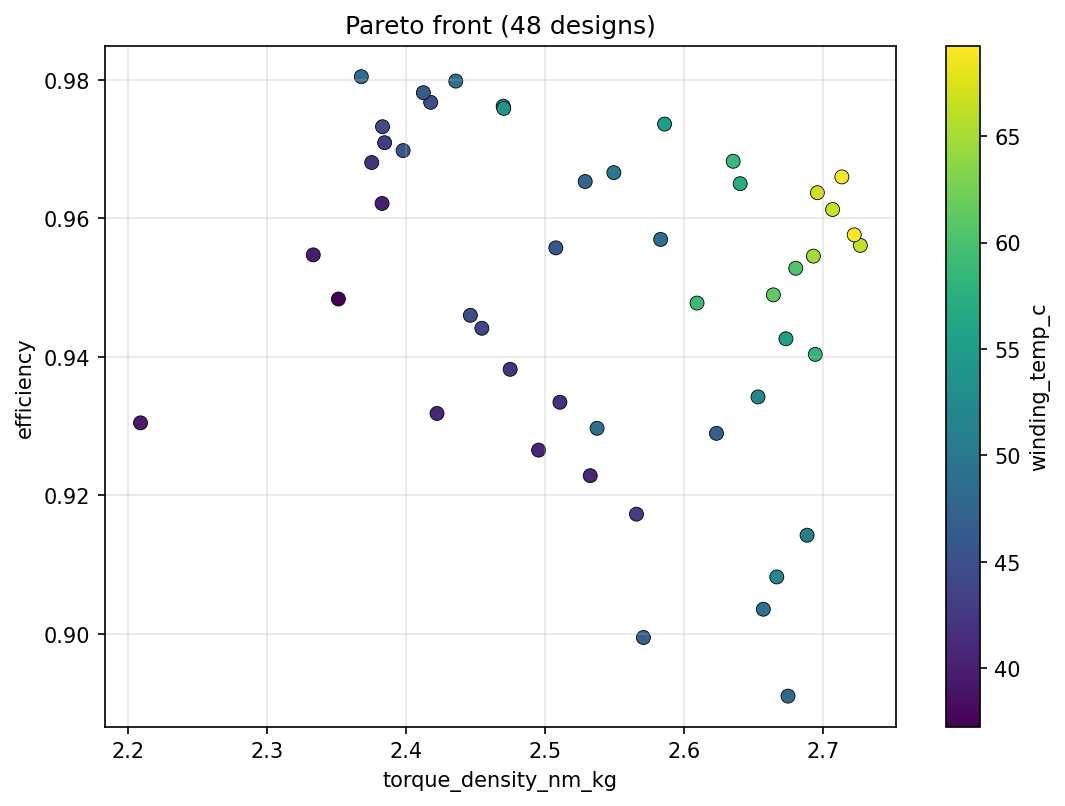
The three-objective reference study renders as x/y position plus color. The spread below the upper envelope comes from the third objective (mass); all points are non-dominated in three dimensions. The torque-density optimum and the efficiency optimum are different machines, which is the argument against optimizing torque density alone.
3. One-at-a-time sensitivities
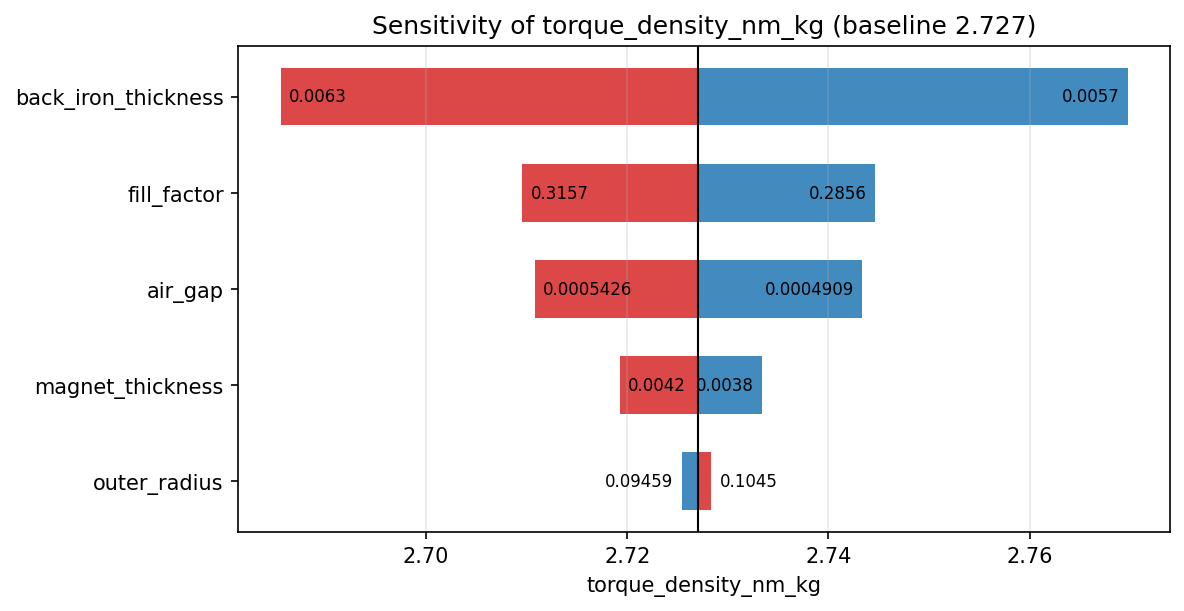
compute_sensitivities perturbs each variable ±5% (clamped to bounds;
discrete variables step one option) and records the output swing, plotted
as a tornado chart. It is a local, one-factor analysis: cheap and interpretable, but blind to
interactions. Use it to rank design levers around a chosen design, not to
certify global behavior.
4. OpenMDAO integration
MotorComponent wraps the model as an om.ExplicitComponent with
finite-difference partials: continuous design variables in, requested result
keys and constraint violations out. The shipped demo runs SLSQP on
torque density with constraints wired as g ≤ 0. Discrete variables are
frozen at their baseline, since gradient drivers cannot move them; discrete
search is the GA's job. The component is the doorway to larger coupled MDO groups
(drivetrain, inverter, structure) per the OpenMDAO philosophy.
See example 05 for the full three-objective study, design selection, tornado chart, and SLSQP refinement.