Orbital data centers, by the numbers
A primer on space-based AI data centers and the technical and economic metrics
that decide their feasibility. It is built on Google's "Project Suncatcher" paper
(arXiv:2511.19468, Nov 2025) and made
reproducible with the spacedc-mdao package: every figure and number below comes
from a model you can run yourself. Where sources disagree, both the optimistic and
the conservative case are shown.
A note on scope: the comparison is for a 1 MW-class design against a hyperscale terrestrial baseline (PUE 1.10). Numbers are illustrative of the method, not a verdict on any specific company's hardware.
Why orbit, why now
Building terrestrial data centers is getting harder. Of the global capacity due online in 2026, 30-50% could be delayed (Sightline Climate, via the Economist, Mar 2026), driven by permitting, grid connections, public opposition, and soaring electricity demand. Orbit sidesteps some of this: a panel in a sun-synchronous orbit sees nearly continuous sunlight and collects on the order of 8x the annual energy of a mid-latitude panel on the ground (Suncatcher).
The Suncatcher moonshot is a constellation of solar-powered satellites carrying AI accelerators, networked by free-space optical links. Google flew a single H100 in LEO (Starcloud-1, Nov 2025) and Starcloud, SpaceX/xAI, and others are pursuing variants. The question this primer addresses is not whether it is possible, but which numbers have to hold for it to be economical.
The architecture
The reference design (Suncatcher) is a fleet of small satellites, each with:
- Solar arrays sized for the accelerator load plus housekeeping, in a dawn-dusk sun-synchronous orbit (~650 km) that stays sunlit ~98% of the time.
- AI accelerators (TPUs or GPUs), radiation-tested for the mission dose. Suncatcher reports Trillium TPUs surviving a 5-year-equivalent total ionizing dose without permanent failures.
- Free-space optical (FSO) inter-satellite links. Bandwidth scales as 1/d², so the satellites fly in close formation (an 81-satellite, 1 km-radius cluster in the paper) to close a ~10 Tbps-per-link budget with commercial DWDM optics.
- A thermal system of heat pipes and radiators — the subsystem that most often decides whether the design closes (see below).
- A ground link for the fraction of work whose results return to Earth.
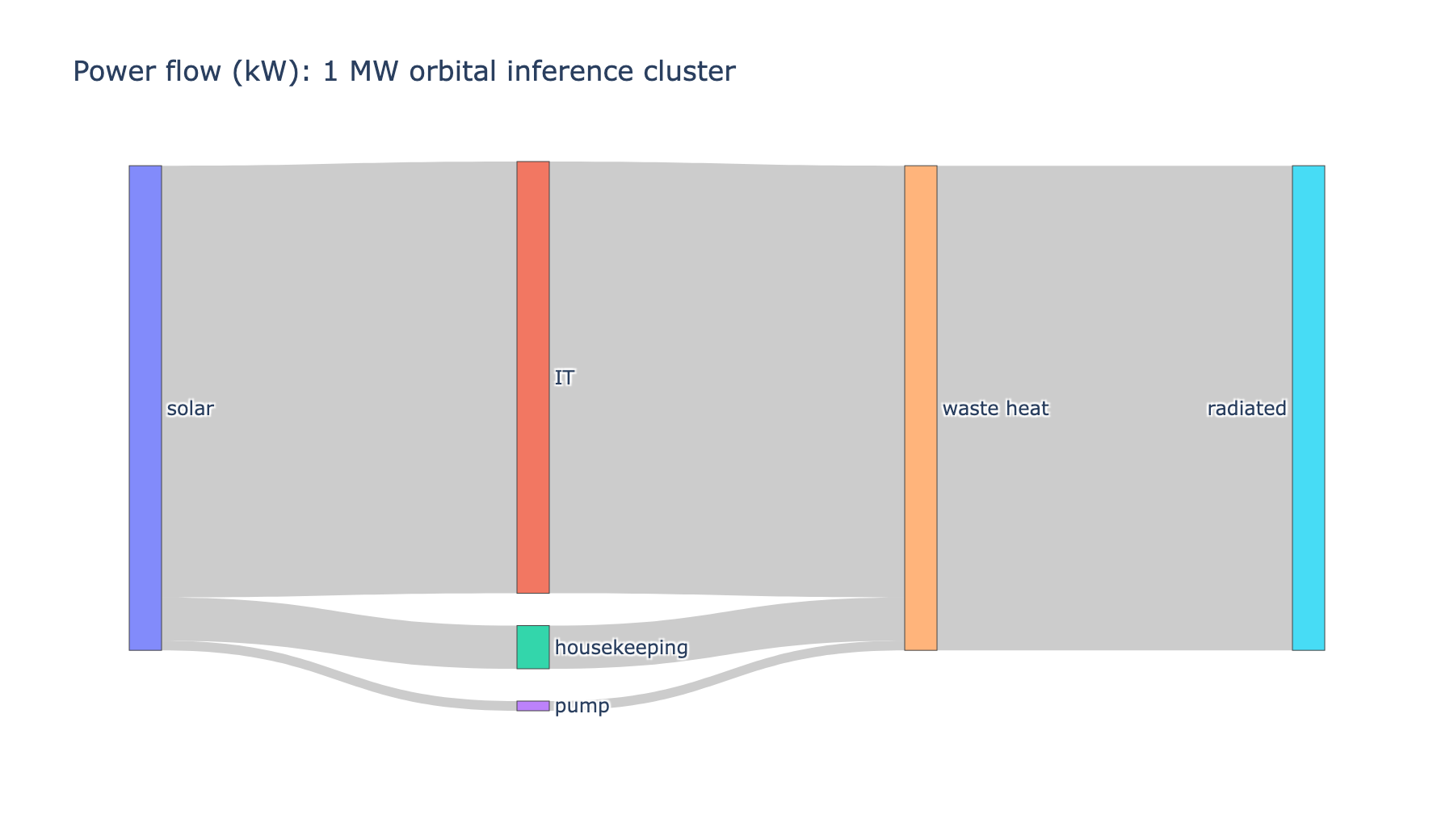
Where the power goes: solar in, accelerators plus housekeeping plus coolant pump, waste heat out through the radiator.
The governing idea: delivered compute, not nominal watts
A satellite's datasheet lists peak FLOP/s. What a data center sells is delivered useful compute, which is the peak degraded by every real constraint:
C_delivered = C_peak · f_software · f_power · f_thermal · f_network · f_availability · f_utilization
Each factor is at most 1. A factor below 1 is compute thrown away by that discipline. The product is usually far below 1, and the binding factor — the one that fails first — is what to fix. For the bundled text-inference design, the waterfall delivers about 29% of nominal; for a communication-heavy design, ~7%.
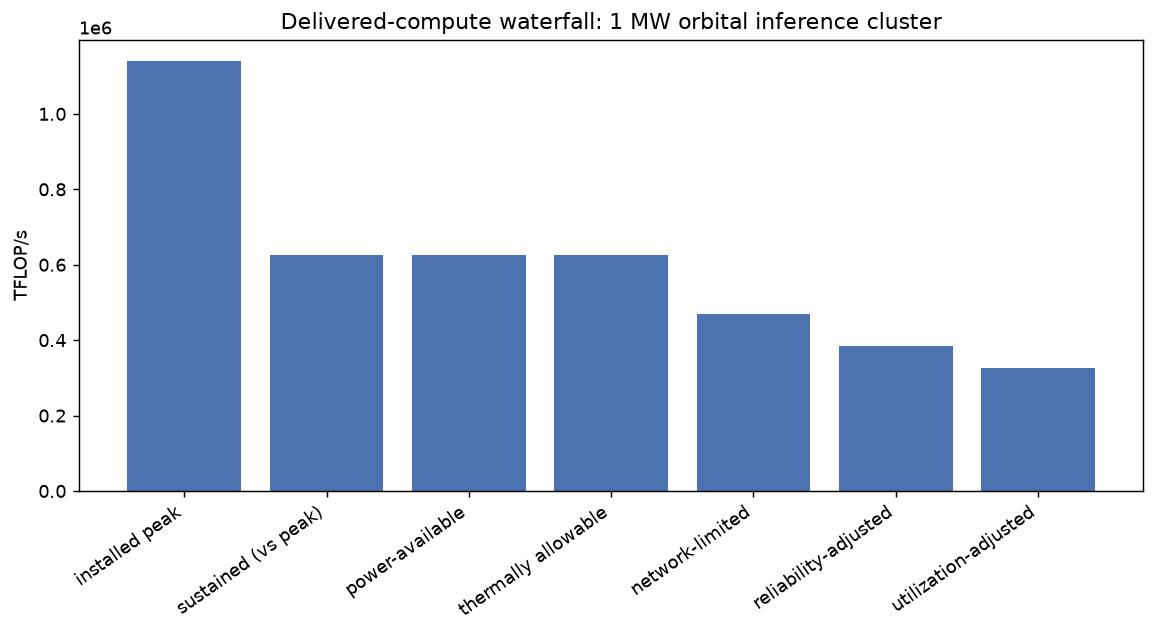
Installed peak degraded to delivered compute. The cost that matters is dollars per delivered PFLOP-day, not dollars per installed watt.
Key technical metrics
Specific power (W/kg). Processing watts per kilogram of satellite. It sets how much compute each kilogram of launch buys. Starlink satellites are ~37 W/kg; Starcloud targets ~70 W/kg; Musk has cited 100 W/kg, and ~150 W/kg is argued as a future ceiling with better cells and flexible arrays. AI satellites can beat Starlink because they skip the phased-array antennas and tight pointing Starlink needs.
Radiator areal mass (kg/kW) and flux (W/m²). Heat can only leave a spacecraft by radiation, which scales with area and the fourth power of temperature. A radiator rejects on the order of 600 W/m² near room temperature (the model reproduces Starcloud's ~633 W/m² figure from the net-flux balance), so a megawatt of waste heat needs hundreds to thousands of square meters of deployable panel. In the bundled design that is ~18 kg/kW of thermal hardware. Thermal closure is the quiet failure mode: power closing does not imply heat can be rejected, and an HBM-temperature limit can bind before the GPU's own junction limit.
Communication intensity (bits/FLOP). Bits that must leave the accelerator per FLOP of compute. This is the single most decisive — and most uncertain — input. Text inference is light: a token is ~32 bits and costs ~2·N_params FLOPs, giving ~1e-8 bits/FLOP. Returning embeddings, images, or other rich artifacts is ~1e-6 to 1e-5 — hundreds of times heavier. Whether the downlink binds depends entirely on which regime the workload is in.
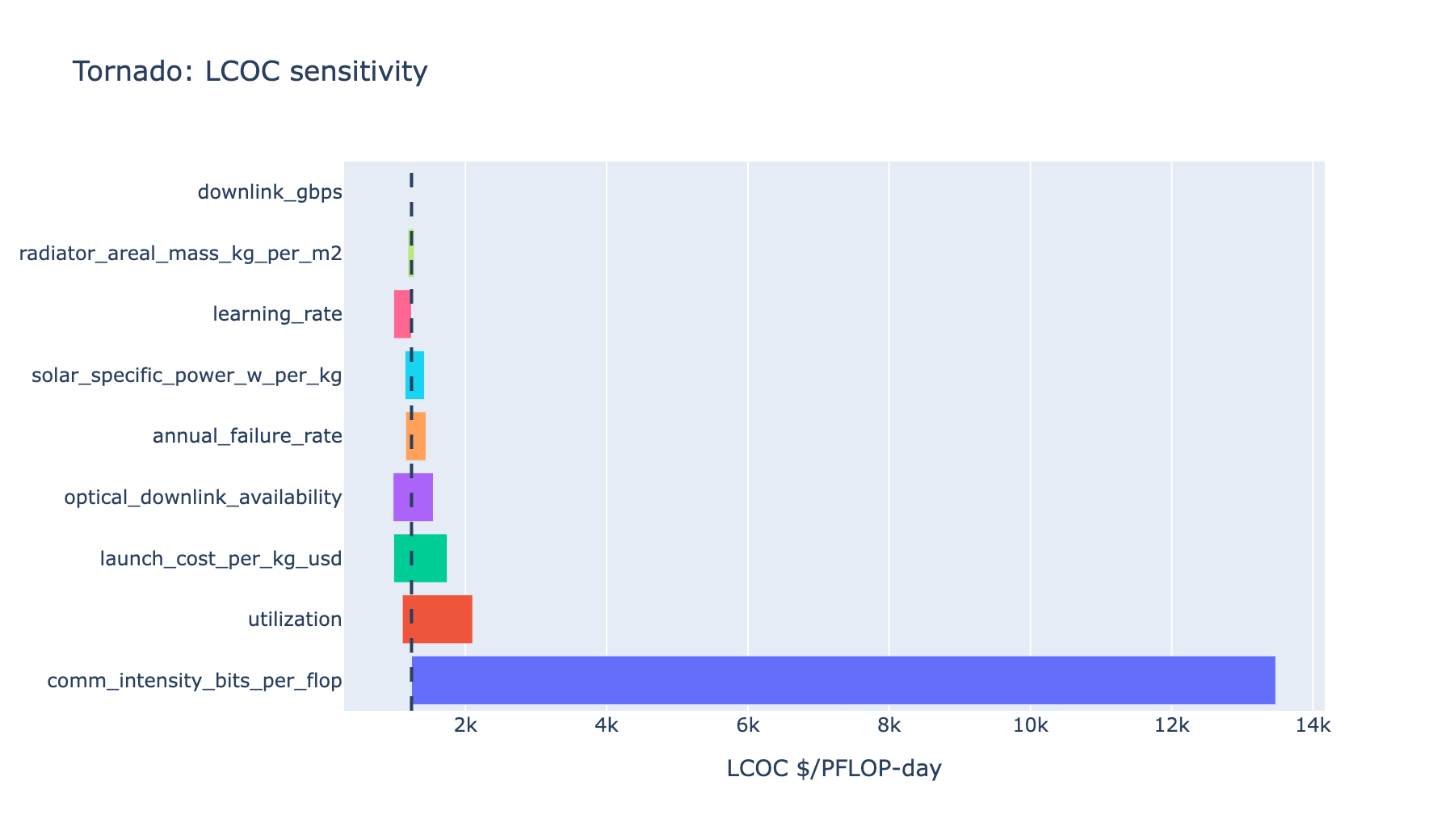
Communication intensity dominates levelized-cost sensitivity, by far.
Crosslink bandwidth. Inter-satellite optical links reach ~10 Tbps per aperture in close formation; the model reproduces ~12.8 Tbps for the paper's 24-channel DWDM, 10 cm aperture, 5 W terminal at 200 m separation. Crosslinks are cheap and fast; the ground downlink is the bottleneck.
Reliability and radiation (failure rate, TID). Accelerators in orbit accrue total ionizing dose and single-event upsets. Calculators assume 5-9% of GPUs fail per year; Starcloud reports its flight unit did better than expected. Lower failure rates mean fewer replacement launches.
Orbit and eclipse. A dawn-dusk sun-synchronous orbit keeps the array sunlit ~98% of the time, minimizing batteries, at the cost of fixed ground-pass geometry.
Key economic metrics
Launch cost ($/kg). The dominant capital input. SpaceX quotes ~$1,500/kg (Falcon Heavy) to ~$3,400/kg (Falcon 9) today; a learning-curve analysis in the Suncatcher paper suggests ≤$200/kg to LEO by the mid-2030s if Starship becomes fully reusable. Launch is also the lever the analysis and the optimists most agree on.
Satellite cost ($/W, GPUs excluded). Dollars per processing watt for the bus, solar, radiator, and comms. Starlink is ~$22/W (down from ~$32/W); Starcloud claims under $5/W for an AI satellite that drops the communications hardware. This is the assumption the conservative model does not reproduce — see below.
Levelized cost of compute (LCOC, $/PFLOP-day). Lifecycle cost divided by delivered PFLOP-days. This is the honest headline because it charges for the delivered-compute waterfall, not just the capacity built.
Capacity capex ($/W of IT power, GPUs excluded). Total build cost per watt, the apples-to-apples figure for capex-style calculators. Useful because GPUs are the same on Earth and in orbit, so they cancel.
Learning curves (Wright's law). Unit cost falls by a fixed fraction per doubling of production. It is how launch reaches $200/kg and how a satellite line reaches $5/W — real, but a projection, not a measurement.
What would have to be true
Running the bundled 1 MW design against a hyperscale Earth baseline (~$66/PFLOP-day, ~$12/W capacity capex):
| Design | LCOC | vs Earth | Binding constraint |
|---|---|---|---|
| Text inference | ~$1,237 | ~19x | optical-downlink availability + capex |
| Rich-output (multimodal) | ~$5,389 | ~82x | downlink bandwidth |
| McCalip-optimistic sliders | ~$428 | ~6x | residual capex + the waterfall |
Three findings hold up:
- The Earth number checks out. Our terrestrial capacity capex (~$12/W ≈ $12bn/GW) lands on McCalip's $15.9bn/GW estimate — a useful validation that the cost model is calibrated.
- Launch is the agreed-on lever. Moving to the speculative $200/kg case drops launch from ~$236/W to ~$11/W, consistent with the optimists. Starship closing the launch gap is the load-bearing assumption everyone shares.
- Satellite cost is the open question. Even with every optimistic slider, the satellite stays ~$200/W against Starcloud's claimed $5/W. That ~40x gap is dominated by the costed power system (solar at $50-60/W in the catalog), comms, and integration. Whether a $5/W AI satellite is buildable is where optimists and the conservative model part ways — see vs the McCalip calculator.
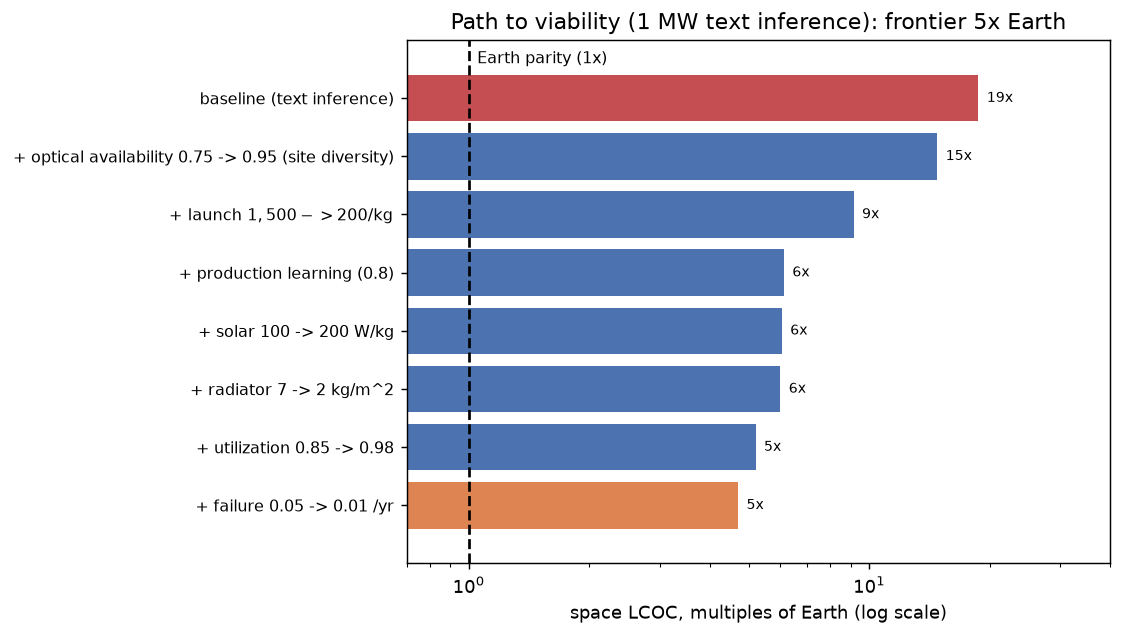
Stacking every optimistic lever on the text-inference design moves it from ~19x to ~5x Earth, but not to parity — the delivered-compute waterfall and the residual capex remain.
The honest verdict: for a 1 MW text-inference workload, Earth wins on levelized cost across the plausible range, and the package finds space beats Earth in 0% of 500 Monte-Carlo draws. The result is most sensitive to the workload's communication intensity, the satellite cost, and the launch price — in that order. None of this says orbital data centers are impossible; it says viability turns on a small, identifiable set of numbers, and two of them (the $5/W satellite, the near-zero-downlink workload) are not yet demonstrated.
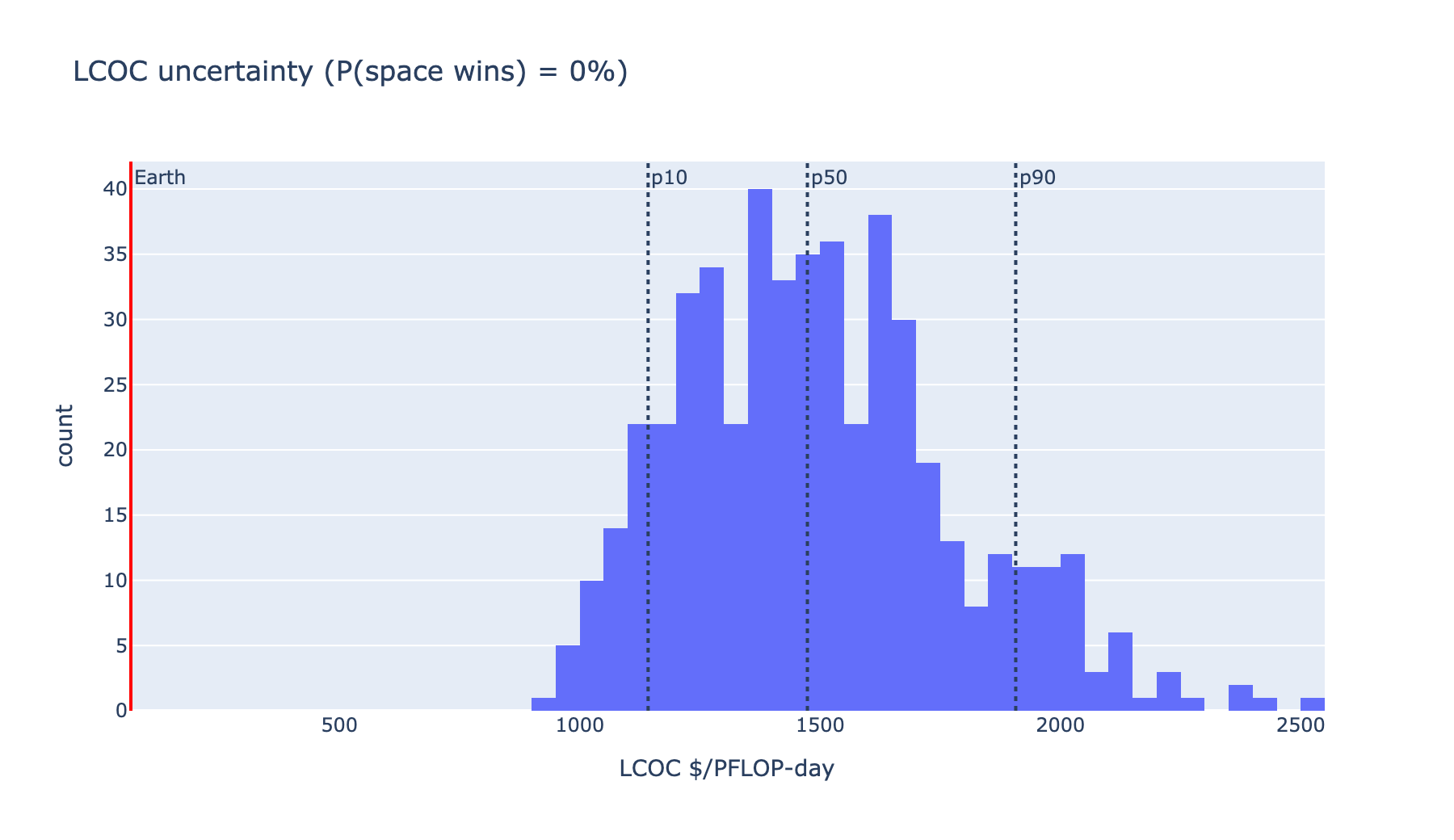
Levelized cost under input uncertainty: the conservative model never crosses the Earth baseline for this workload.
Reproduce it yourself
Every number above is regenerable:
pip install spacedc-mdao

# the honest headline for text inference
orbitdc compare examples/scenarios/orbital_1mw_inference.yaml \
  examples/scenarios/earth_hyperscale_baseline.yaml --tornado

# the downlink-bound regime
orbitdc compare examples/scenarios/orbital_multimodal_inference.yaml \
  examples/scenarios/earth_hyperscale_baseline.yaml

# the McCalip-optimistic sliders
orbitdc compare examples/scenarios/orbital_mccalip_optimistic.yaml \
  examples/scenarios/earth_hyperscale_baseline.yaml
Change any assumption (launch $/kg, W/kg, $/W, bits/FLOP, failure rate) in the scenario YAML or as a sensitivity sweep, and watch the binding constraint move. The quick start, model architecture, and governing equations pages go deeper; every default carries provenance.
References
- B. Agüera y Arcas et al., "Towards a future space-based, highly scalable AI infrastructure system design" (Project Suncatcher), arXiv:2511.19468, Nov 2025.
- The Economist, "Data centres in space: less crazy than you think," 2 Mar 2026.
- A. McCalip, orbital data center cost calculator, andrewmccalip.com.
- Starcloud, Starcloud-1 mission (H100 in LEO, Nov 2025).
- NASA/MIT Lincoln Laboratory, TBIRD 200 Gbps optical downlink demonstration, 2023.
spacedc-mdao: https://github.com/jman4162/spacedc-mdao · https://pypi.org/project/spacedc-mdao/